I am a Ramón y Cajal fellow working at ICMM-CSIC in the Theory of Quantum Materials for Quantum Technologies group on semiconductor-based quantum computation and hybrid quantum devices. Not too long ago I used to be a postdoctoral researcher at the CEA-Grenoble in the L-Sim group, where I worked from 2020 to 2023. Prior to this, I was also a postdoc at the University of Wisconsin-Madison in the Silicon Qubit Theory Group from 2018 to 2020.
My research focuses on quantum computation in condensed matter systems. In particular, I enjoy developing theory for the quantum phenomena that naturally arises in realistic devices, connecting directly with experimental results. I perform analytical and numerical calculations of such phenomena to optimize quantum operations.
Recent advances in the scaling of spin qubits have led to the development of sparse architectures where spin qubits are distributed across multiple quantum dots. This distributed approach enables qubit manipulation through hopping and flopping modes, as well as protocols for spin shuttling to entangle spins beyond nearest neighbors. Therefore, understanding spin tunneling across quantum dots is fundamental for the improvement of sparse array encodings. Here, we develop a microscopic theory of a minimal sparse array formed by a hole in a double quantum dot. We show the existence of spin-dependent magnetic corrections to the tunnel couplings that help preserve existing sweet spots, even for quantum dots with different -factors, and introduce new ones that are not accounted for in the simplest models. Our analytical and numerical results explain observed sweet spots in state-of-the-art shuttling and cQED experiments, are relevant to hopping and flopping modes, and apply broadly to sparse array encodings of any size.
@article{sagaseta2025switchable,title={Sweet-spot protection of hole spins in sparse arrays via spin-dependent magneto-tunneling},author={Rodr{\'\i}guez-Mena, Esteban A and Mart{\'\i}nez, Biel and Kalo, Ahmad Fouad and Niquet, Yann-Michel and Abadillo-Uriel, Jose Carlos},year={2025},doi={arXiv:2510.25857v1},}
Switchable spin-photon coupling with hole spins in single-quantum dots
Carlos Sagaseta, Marı́a José Calderón, and Jose Carlos Abadillo-Uriel
Spin qubits in semiconductor quantum dots offer a gate-tunable platform for quantum information processing. While two-qubit interactions are typically realized through exchange coupling between neighboring spins, coupling spin qubits to photons via hybrid spin-cQED devices enables long-range interactions and integration with other cQED platforms. Here, we investigate hole spin-photon coupling in compact single quantum dot setups. By incorporating ubiquitous strain inhomogeneities to our theory, we identify three main spin-photon coupling channels: a vector-potential-spin-orbit geometric mechanism–dominant for vertical magnetic fields–, an inhomogeneous Rashba term generalizing previous spin-orbit field models, and strain-induced -tensor terms–most relevant for in-plane fields. Comparing Si, unstrained (relaxed) Ge, and biaxially strained Ge wells, we find that Si and unstrained Ge provide optimal coupling strengths (tens of MHz) thanks to their reduced heavy-hole, light-hole splitting. We demonstrate efficient switching of the spin-photon coupling while preserving sweet spot operation. Finally, we evaluate quantum state transfer and two-qubit gate protocols, achieving >99% fidelity for state transfer and >90%for two-qubit gates with realistic coherence times, establishing single-dot hole spins as a viable platform for compact spin-cQED architectures and highlighting unstrained Ge as a promising candidate for spin-photon interactions.
@article{sagaseta2025switchablf,title={Switchable spin-photon coupling with hole spins in single-quantum dots},author={Sagaseta, Carlos and Calder{\'o}n, Mar{\'\i}a Jos{\'e} and Abadillo-Uriel, Jose Carlos},year={2025},doi={arXiv:2510.05301v1},}
Coherence of a hole spin flopping-mode qubit in a circuit quantum electrodynamics environment
Léo Noirot, Cécile X Yu, Jose Carlos Abadillo-Uriel, Étienne Dumur, Heimanu Niebojewski, Benoit Bertrand, and 2 more authors
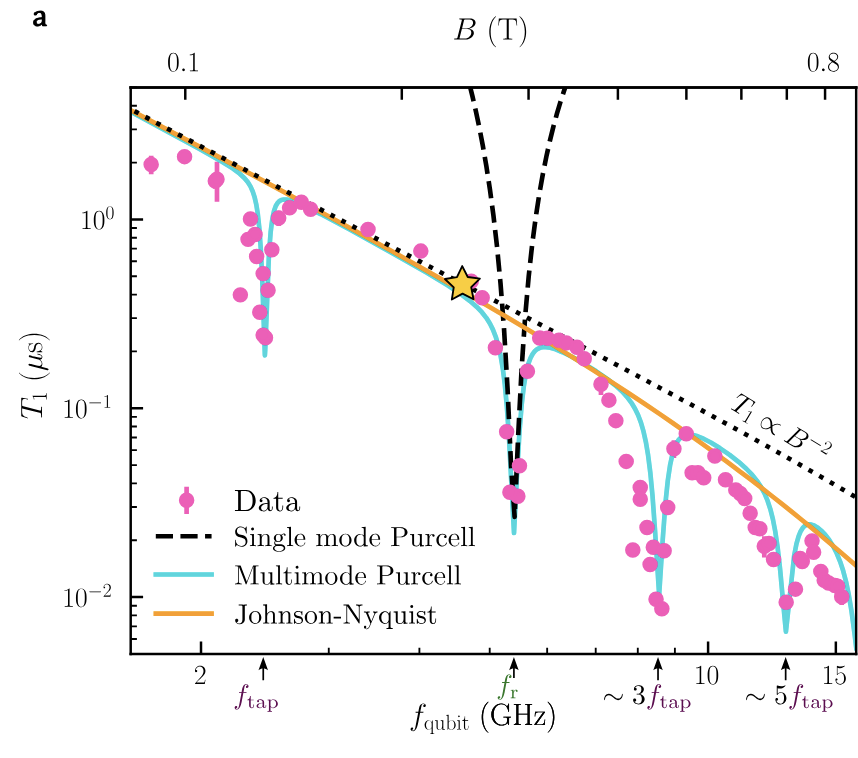
The entanglement of microwave photons and spin qubits in silicon represents a pivotal step forward for quantum information processing utilizing semiconductor quantum dots. Such hybrid spin circuit quantum electrodynamics (cQED) has been achieved by granting a substantial electric dipole moment to a spin by de-localizing it in a double quantum dot under spin-orbit interaction, thereby forming a flopping-mode (FM) spin qubit. Despite its promise, the coherence properties demonstrated to date remain insufficient to envision FM spin qubits as practical single qubits. Here, we present a FM hole spin qubit in a silicon nanowire coupled to a high-impedance niobium nitride microwave resonator for readout. We report Rabi frequencies exceeding 100 MHz and coherence times in the microsecond range, resulting in a high single gate quality factor of 380. This establishes FM spin qubits as fast and reliable qubits. Moreover, using the large frequency tunability of the FM qubit, we reveal for the first time that photonic effects predominantly limit coherence, with radiative decay being the main relaxation channel and photon shot-noise inducing dephasing. These results highlight that optimized microwave engineering can unlock the potential of FM spin qubits in hybrid cQED architectures, offering a scalable and robust platform for fast and coherent spin qubits with strong coupling to microwave photons.
@article{noirot2025coherence,title={Coherence of a hole spin flopping-mode qubit in a circuit quantum electrodynamics environment},author={Noirot, L{\'e}o and Yu, C{\'e}cile X and Abadillo-Uriel, Jose Carlos and Dumur, {\'E}tienne and Niebojewski, Heimanu and Bertrand, Benoit and Maurand, Romain and Zihlmann, Simon},year={2025},doi={arXiv:2503.10788v1},}
Theory of superconducting proximity effect in hole-based hybrid semiconductor-superconductor devices
D Michel Pino, Rubén Seoane-Souto, Maria José Calderón, Ramón Aguado, and Jose Carlos Abadillo-Uriel
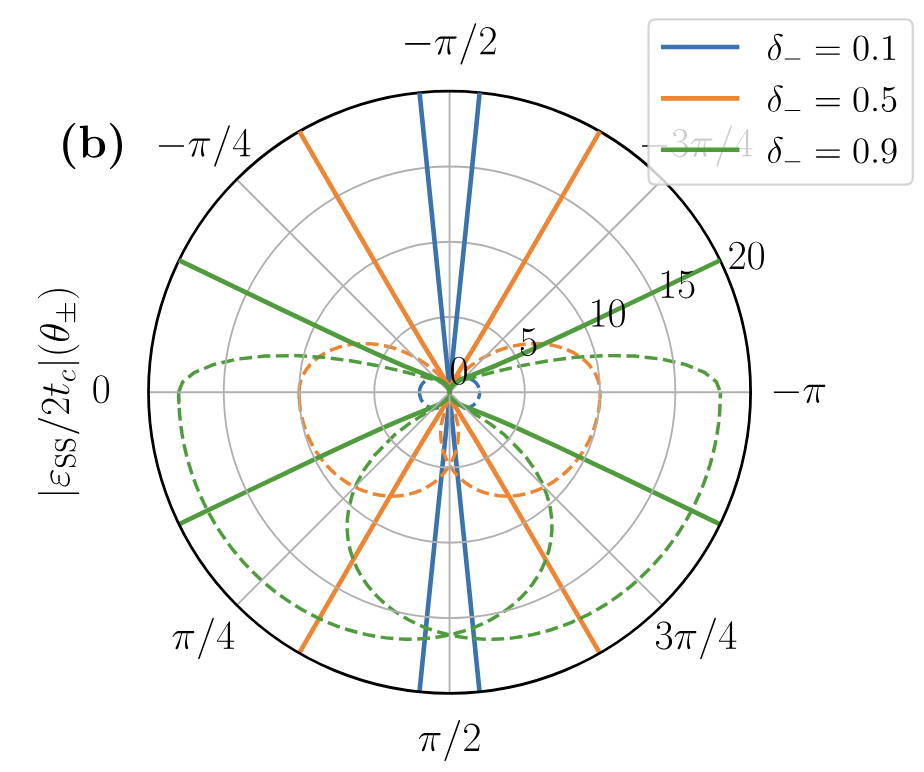
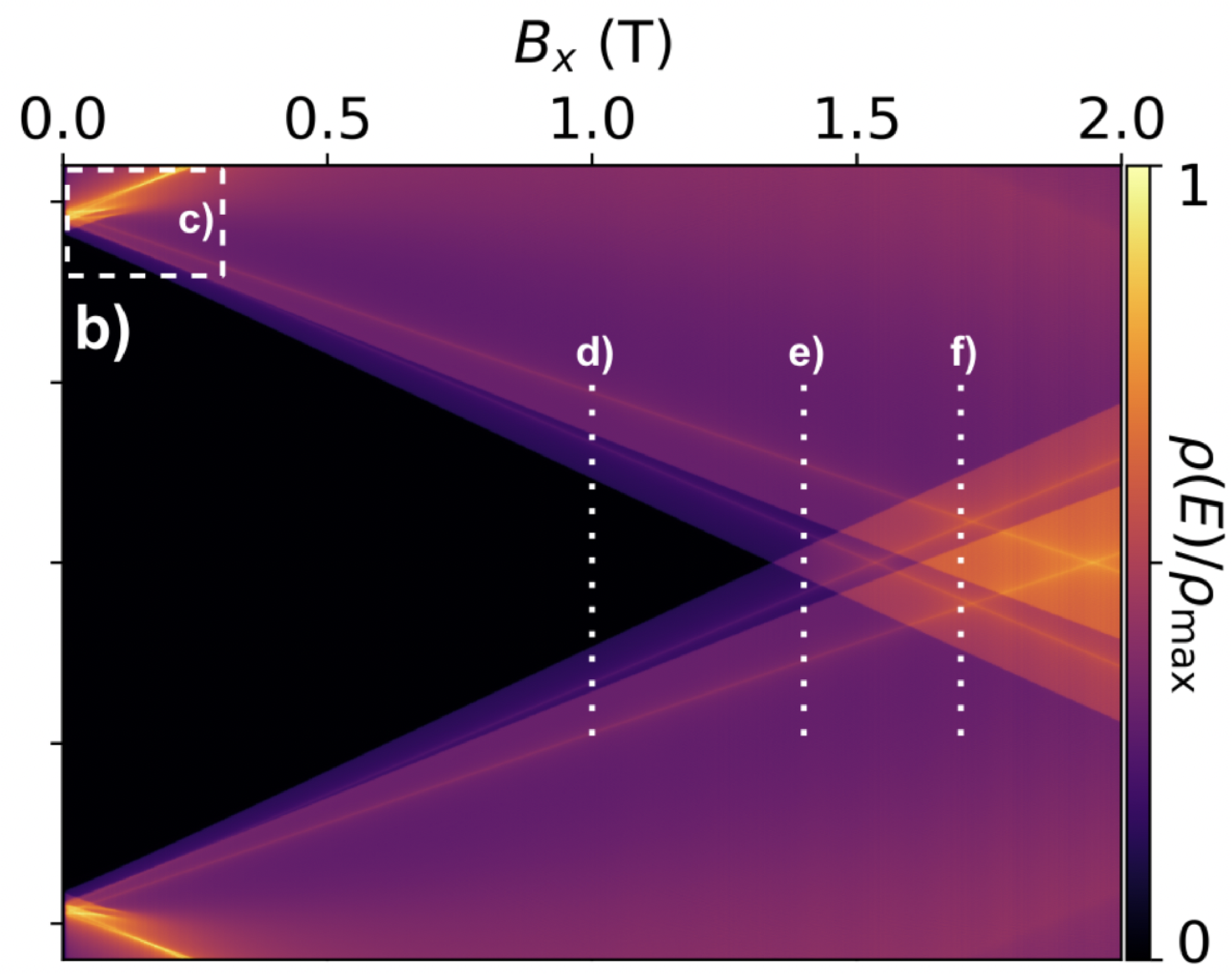
Hybrid superconductor-semiconductor systems have received a great deal of attention in the last few years because of their potential for quantum engineering, including novel qubits and topological devices. The proximity effect, the process by which the semiconductor inherits superconducting correlations, is an essential physical mechanism of such hybrids. Recent experiments have demonstrated the proximity effect in hole-based semiconductors, but, in contrast to electrons, the precise mechanism by which the hole bands acquire superconducting correlations remains an open question. In addition, hole spins exhibit a complex strong spin-orbit interaction, with largely anisotropic responses to electric and magnetic fields, further motivating the importance of understanding the interplay between such effects and the proximity effect. In this work, we analyze this physics with focus on germanium-based two-dimensional gases. Specifically, we develop an effective theory supported by full numerics, allowing us to extract various analytical expressions and predict different types of superconducting correlations including non-standard forms of singlet and triplet pairing mechanisms with non-trivial momentum dependence; as well as different Zeeman and Rashba spin-orbit contributions. This, together with their precise dependence on electric and magnetic fields, allows us to make specific experimental predictions, including the emergence of f-type superconductivity, Bogoliubov Fermi surfaces, and gapless regimes caused by large in-plane magnetic fields.
@article{pino2024theory,title={Theory of superconducting proximity effect in hole-based hybrid semiconductor-superconductor devices},author={Pino, D Michel and Seoane-Souto, Rub{\'e}n and Calder{\'o}n, Maria Jos{\'e} and Aguado, Ram{\'o}n and Abadillo-Uriel, Jose Carlos},journal={Physical Review B},volume={111},number={23},pages={235443},year={2025},publisher={APS},doi={10.1103/mmsd-wfnf},}
Optimal operation of hole spin qubits
Marion Bassi, Esteban-Alonso Rodrıguez-Mena, Boris Brun, Simon Zihlmann, Thanh Nguyen, Victor Champain, and 5 more authors
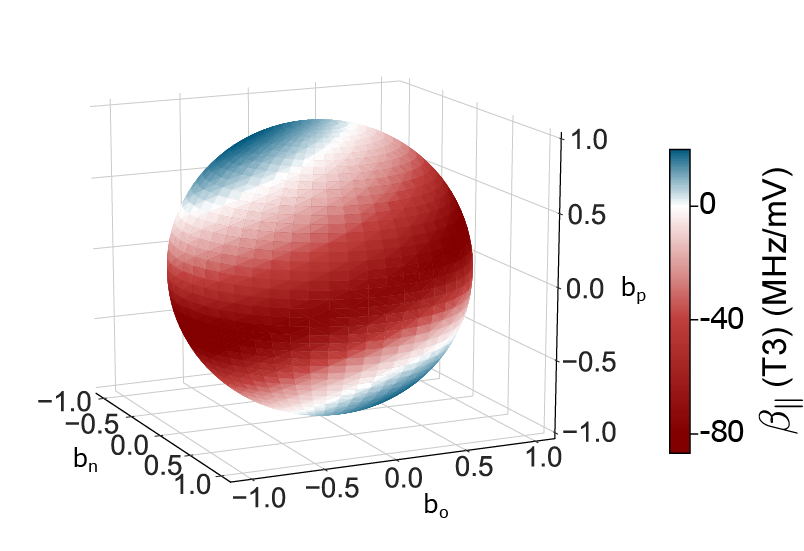
Hole spins in silicon or germanium quantum dots have emerged as a compelling solid-state platform for scalable quantum processors. Besides relying on well-established manufacturing technologies, hole-spin qubits feature fast, electric-field-mediated control stemming from their intrinsically large spin-orbit coupling [1, 2]. This key feature is accompanied by an undesirable susceptibility to charge noise, which usually limits qubit coherence. Here, by varying the magnetic-field orientation, we experimentally establish the existence of “sweetlines” in the polar-azimuthal manifold where the qubit is insensitive to charge noise. In agreement with recent predictions [3], we find that the observed sweetlines host the points of maximal driving efficiency, where we achieve fast Rabi oscillations with quality factors as high as 1200. Furthermore, we demonstrate that moderate adjustments in gate voltages can significantly shift the sweetlines. This tunability allows multiple qubits to be simultaneously made insensitive to electrical noise, paving the way for scalable qubit architectures that fully leverage all-electrical spin control. The conclusions of this experimental study, performed on a silicon metal-oxide-semiconductor device, are expected to apply to other implementations of hole spin qubits.
@article{bassi2024optimal,title={Optimal operation of hole spin qubits},author={Bassi, Marion and Rodr{\i}guez-Mena, Esteban-Alonso and Brun, Boris and Zihlmann, Simon and Nguyen, Thanh and Champain, Victor and Abadillo-Uriel, Jose Carlos and Bertrand, Benoit and Niebojewski, Heimanu and Maurand, Romain and others},journal={Nature Physics},year={2025},url={https://www.nature.com/articles/s41567-025-03106-1},doi={10.1038/s41567-025-03106-1},}
Unifying Floquet theory of longitudinal and dispersive readout
Alessandro Chessari, Esteban A Rodrı́guez-Mena, Jose Carlos Abadillo-Uriel, Victor Champain, Simon Zihlmann, Romain Maurand, and 2 more authors
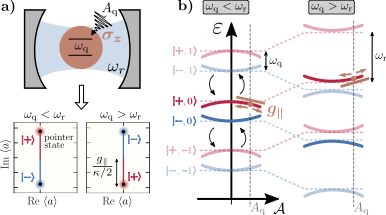
We devise a Floquet theory of longitudinal and dispersive readout in circuit QED. By studying qubits coupled to cavity photons and driven at the resonance frequency of the cavity ωr, we establish a universal connection between the qubit AC Stark shift and the longitudinal and dispersive coupling to photons. We find that the longitudinal coupling g∥ is controlled by the slope of the AC Stark shift as function of the driving strength Aq, while the dispersive shift χ depends on its curvature. The two quantities become proportional to each other in the weak drive limit (Aq→0). Our approach unifies the adiabatic limit (ωr→0) – where g∥ is generated by the static spectrum curvature (or quantum capacitance) – with the diabatic one, where the static spectrum plays no role. We derive analytical results supported by exact numerical simulations. We apply them to superconducting and spin-hybrid cQED systems, showcasing the flexibility of faster-than-dispersive longitudinal readout.
@article{chessari2024unifying,title={Unifying Floquet theory of longitudinal and dispersive readout},author={Chessari, Alessandro and Rodr{\'\i}guez-Mena, Esteban A and Abadillo-Uriel, Jose Carlos and Champain, Victor and Zihlmann, Simon and Maurand, Romain and Niquet, Yann-Michel and Filippone, Michele},journal={Physical Review Letters},volume={134},number={3},pages={037003},year={2025},publisher={APS},doi={10.1103/PhysRevLett.134.037003},}
Non-symmetric Pauli spin blockade in a silicon double quantum dot
Theodor Lundberg, David J Ibberson, Jing Li, Louis Hutin, Jose C Abadillo-Uriel, Michele Filippone, and 5 more authors
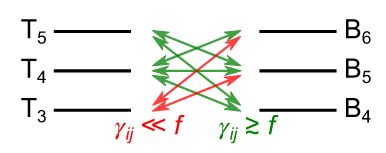
Spin qubits in gate-defined silicon quantum dots are receiving increased attention thanks to their potential for large-scale quantum computing. Readout of such spin qubits is done most accurately and scalably via Pauli spin blockade (PSB), however various mechanisms may lift PSB and complicate readout. In this work, we present an experimental observation of a new, highly prevalent PSB-lifting mechanism in a silicon double quantum dot due to incoherent tunneling between different spin manifolds. Through dispersively-detected magnetospectroscopy of the double quantum dot in 16 charge configurations, we find the mechanism to be energy-level selective and non-reciprocal for neighbouring charge configurations. Additionally, using input-output theory we report a large coupling of different electron spin manifolds of 7.90 μeV, the largest reported to date, indicating an enhanced spin-orbit coupling which may enable all-electrical qubit control.
@article{lundberg2024non,title={Non-symmetric Pauli spin blockade in a silicon double quantum dot},author={Lundberg, Theodor and Ibberson, David J and Li, Jing and Hutin, Louis and Abadillo-Uriel, Jose C and Filippone, Michele and Bertrand, Benoit and Nunnenkamp, Andreas and Lee, Chang-Min and Stelmashenko, Nadia and others},journal={npj Quantum Information},volume={10},number={1},pages={28},year={2024},publisher={Nature Publishing Group UK London},url={https://www.nature.com/articles/s41534-024-00820-1},doi={10.1038/s41534-024-00820-1},}
Linear-in-momentum spin orbit interactions in planar Ge/GeSi heterostructures and spin qubits
Esteban A Rodriguez-Mena, Jose Carlos Abadillo-Uriel, Gaëtan Veste, Biel Martinez, Jing Li, Benoı̂t Sklénard, and 1 more author
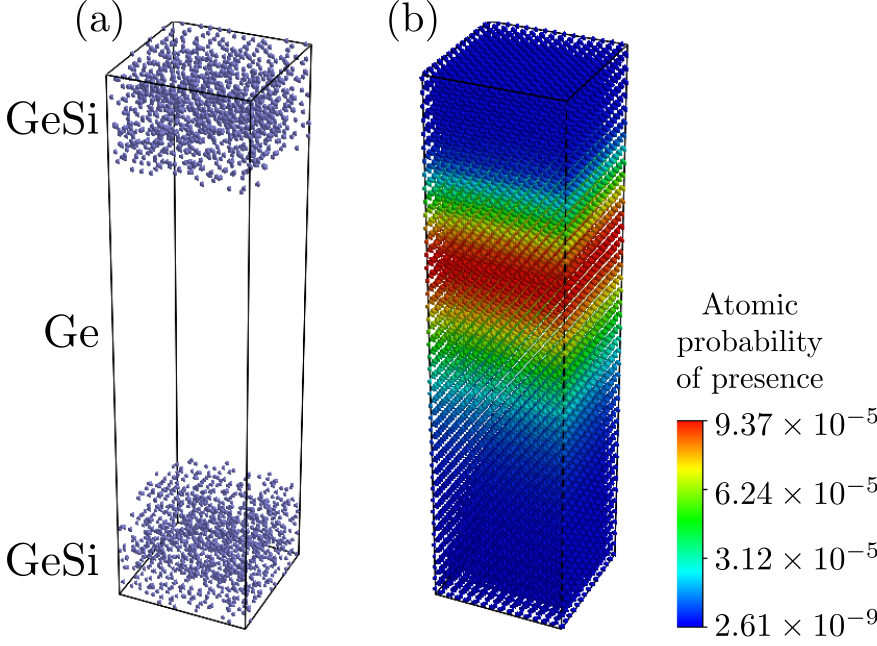
We investigate the existence of linear-in-momentum spin-orbit interactions in the valence band of Ge/GeSi heterostructures using an atomistic tight-binding method. We show that symmetry breaking at the Ge/GeSi interfaces gives rise to a linear Dresselhaus-type interaction for heavy-holes. This interaction results from the heavy-hole/light-hole mixings induced by the interfaces and can be captured by a suitable correction to the minimal Luttinger-Kohn, four bands k⃗ ⋅p⃗ Hamiltonian. It is dependent on the steepness of the Ge/GeSi interfaces, and is suppressed if interdiffusion is strong enough. Besides the Dresselhaus interaction, the Ge/GeSi interfaces also make a contribution to the in-plane gyromagnetic g-factors of the holes. The tight-binding calculations also highlight the existence of a small linear Rashba interaction resulting from the couplings between the heavy-hole/light-hole manifold and the conduction band enabled by the low structural symmetry of Ge/GeSi heterostructures. These interactions can be leveraged to drive the hole spin. The linear Dresselhaus interaction may, in particular, dominate the physics of the devices for out-of-plane magnetic fields. When the magnetic field lies in-plane, it is, however, usually far less efficient than the g-tensor modulation mechanisms arising from the motion of the dot in non-separable, inhomogeneous electric fields and strains.
@article{rodriguez2023linear,title={Linear-in-momentum spin orbit interactions in planar Ge/GeSi heterostructures and spin qubits},author={Rodriguez-Mena, Esteban A and Abadillo-Uriel, Jose Carlos and Veste, Ga{\"e}tan and Martinez, Biel and Li, Jing and Skl{\'e}nard, Beno{\^\i}t and Niquet, Yann-Michel},journal={Physical Review B},volume={108},number={20},pages={205416},year={2023},publisher={APS},doi={10.1103/PhysRevB.108.205416},}